What ?
In this project, the Arduino Uno was used, but you can use other boards like Arduino Nano or Micro, Miga 2560, ESP32...
below a comparaison of some Arduino boards:
| Feature | Arduino Uno | Arduino Nano | Arduino Micro | Arduino Mega 2560 | ESP32 |
|---|---|---|---|---|---|
| Microcontroller | ATmega328P | ATmega328P | ATmega32U4 | ATmega2560 | Tensilica Xtensa LX6 |
| Operating Voltage | 5V | 5V | 5V | 5V | 3.3V |
| Input Voltage | 7-12V | 7-12V | 7-12V | 7-12V | 5V via USB or 7-12V |
| Digital I/O Pins | 14 (6 PWM) | 14 (6 PWM) | 20 (7 PWM) | 54 (15 PWM) | 34 |
| Analog Input Pins | 6 | 8 | 12 | 16 | 18 |
| Flash Memory | 32 KB | 32 KB | 32 KB | 256 KB | Up to 16 MB |
| SRAM | 2 KB | 2 KB | 2.5 KB | 8 KB | 520 KB |
| EEPROM | 1 KB | 1 KB | 1 KB | 4 KB | None |
| Clock Speed | 16 MHz | 16 MHz | 16 MHz | 16 MHz | 240 MHz (dual-core) |
| Connectivity | UART, I2C, SPI | UART, I2C, SPI | UART, I2C, SPI | UART, I2C, SPI | Wi-Fi, Bluetooth |
| USB Interface | USB-B | Mini USB | Micro USB | USB-B | Micro USB |
| Dimensions | 68.6 x 53.4 mm | 45 x 18 mm | 48 x 18 mm | 101.52 x 53.3 mm | 51 x 25.5 mm |
| Power Consumption | ~50 mA | ~50 mA | ~50 mA | ~70 mA | Varies (~80-240 mA) |
| Special Features | Simple and robust | Compact | USB HID support | High I/O count | Wi-Fi and BLE |
| Price Range | Low | Low | Medium | Medium | Medium-High |
import pandas as pd
import numpy as np
from sklearn.model_selection import train_test_split
from sklearn.metrics import accuracy_score
from sklearn.metrics import mean_absolute_error
from sklearn.ensemble import RandomForestRegressor
from sklearn.tree import DecisionTreeRegressor
import xgboost as xgb
import tensorflow as tf
import matplotlib.pyplot as plt
import seaborn as sns
# save models
import joblib
import pickle
import os
import re
import json
# Load dataset
file = r"https://raw.githubusercontent.com/bouz1/Manipulation_of_second_hand_vehicles_data/refs/heads/main/datasets/used_cars_data_250.csv"
df=pd.read_csv(file)
len(df)
7250
df.info()
<class 'pandas.core.frame.DataFrame'> RangeIndex: 7250 entries, 0 to 7249 Data columns (total 16 columns): # Column Non-Null Count Dtype --- ------ -------------- ----- 0 model1 7250 non-null object 1 model2 7250 non-null object 2 version 7250 non-null object 3 price 7250 non-null float64 4 km 7250 non-null float64 5 fuel 7250 non-null float64 6 CV_fisc 7250 non-null float64 7 HorseP 7250 non-null float64 8 Gearbox_auto 7250 non-null float64 9 L_by_100km 7250 non-null float64 10 numbe_seats 7250 non-null float64 11 doors_nb 7250 non-null float64 12 Euro_stand 7250 non-null float64 13 Length 7250 non-null float64 14 Nb_option 7250 non-null float64 15 registration_date 7250 non-null float64 dtypes: float64(13), object(3) memory usage: 906.4+ KB
df.head(2)
| model1 | model2 | version | price | km | fuel | CV_fisc | HorseP | Gearbox_auto | L_by_100km | numbe_seats | doors_nb | Euro_stand | Length | Nb_option | registration_date | |
|---|---|---|---|---|---|---|---|---|---|---|---|---|---|---|---|---|
| 0 | RENAULT | MEGANE 4 | IV 1.6 TCE 205 ENERGY GT EDC7 | 23440.0 | 78325.0 | 0.0 | 11.0 | 205.0 | 1.0 | 4.9 | 5.0 | 5.0 | 6.0 | 4.36 | 40.0 | 3183.0 |
| 1 | RENAULT | CLIO 5 | V 1.0 TCE 100 INTENS | 19930.0 | 27008.0 | 0.0 | 5.0 | 101.0 | 0.0 | 5.3 | 5.0 | 5.0 | 6.0 | 4.05 | 11.0 | 4085.0 |
df.isna().sum()
model1 0 model2 0 version 0 price 0 km 0 fuel 0 CV_fisc 0 HorseP 0 Gearbox_auto 0 L_by_100km 0 numbe_seats 0 doors_nb 0 Euro_stand 0 Length 0 Nb_option 0 registration_date 0 dtype: int64
df.columns
Index(['model1', 'model2', 'version', 'price', 'km', 'fuel', 'CV_fisc',
'HorseP', 'Gearbox_auto', 'L_by_100km', 'numbe_seats', 'doors_nb',
'Euro_stand', 'Length', 'Nb_option', 'registration_date'],
dtype='object')
df.price.describe().to_frame().T
| count | mean | std | min | 25% | 50% | 75% | max | |
|---|---|---|---|---|---|---|---|---|
| price | 7250.0 | 41867.362759 | 69438.583438 | 4910.0 | 18010.0 | 24470.0 | 35680.0 | 793620.0 |
df2= df[df.price <40000]
len(df2)/len(df)
0.8137931034482758
df3= df2[['km', 'fuel', 'CV_fisc','HorseP', 'Gearbox_auto',
'L_by_100km', 'numbe_seats', 'doors_nb',
'Euro_stand', 'Length', 'Nb_option', 'price']]
correlation_matrix= df3.corr()
plt.figure(figsize=(10, 8))
sns.heatmap(correlation_matrix, annot=True, cmap='coolwarm', fmt=".2f")
plt.title('Correlation Heatmap')
plt.show()
plt.figure(figsize=(8, 3))
S= correlation_matrix["price"].drop("price")
S=S.abs().sort_values(ascending=False)
S.plot.bar()
plt.grid()
plt.xlabel("features")
plt.ylabel("Abs correlation")
plt.title("Feature correlation with Price")
plt.show()
colsx=['km', 'fuel', 'CV_fisc','HorseP', 'Gearbox_auto',
'L_by_100km', 'numbe_seats', 'doors_nb',
'Euro_stand', 'Length', 'Nb_option']
coly= 'price'
X= df3[colsx].values
y= df3[ coly].values
# Split into training and test sets
X_train, X_test, y_train, y_test = train_test_split(X, y, test_size=0.2, random_state=42)
Use Xgboost to select only 4 inputs
# Define and train the model
model = xgb.XGBRegressor(
n_estimators=100, # Number of trees
max_depth=3, # Maximum tree depth
eta=0.1, # Learning rate
objective='reg:squarederror' # Regression objective
,random_state=42
)
model.fit(X_train, y_train)
importance = model.feature_importances_
S=pd.Series(importance, index = colsx)
S=S.sort_values(ascending=False)
plt.figure(figsize=(8, 3))
S.plot.bar()
plt.grid()
plt.xlabel("features")
plt.ylabel("Importance using XGboost")
plt.title("Feature impotances using XGboost")
plt.show()
print("The 4 important features: ", list(S.head(4).index))
The 4 important features: ['Gearbox_auto', 'HorseP', 'Euro_stand', 'km']
NewColx= list(S.head(4).index)
NewColx
['Gearbox_auto', 'HorseP', 'Euro_stand', 'km']
FileName="..\data\processed\df_price_4inputs.csv"
df3[NewColx+["price"]].astype("float32").\
to_csv(FileName,
index = False)
FileName="..\data\processed\df_price_4inputs.csv"
dfnew= pd.read_csv(FileName).astype("float32")
print("Df columns: ", list(dfnew.columns))
X= dfnew.iloc[:,:4].values
y= dfnew.iloc[:,4].values
# Split into training and test sets
X_train, X_test, y_train, y_test = train_test_split(X, y, test_size=0.2, random_state=42)
Df columns: ['Gearbox_auto', 'HorseP', 'Euro_stand', 'km', 'price']
from sklearn.linear_model import LinearRegression
LR = LinearRegression()
_=LR.fit(X_train, y_train)
# Save the model
joblib.dump(LR, r'../models/LinearReg/LR_model.pkl')
['../models/LinearReg/LR_model.pkl']
# Load the model
LR_model = joblib.load(r'../models/LinearReg/LR_model.pkl')
y_pred_test= LR_model.predict(X_test)
y_pred_train= LR_model.predict(X_train)
# Evaluate the model
maeTrain = mean_absolute_error(y_train, y_pred_train)
print(f"Mean Squared Error Train: {maeTrain:.2f}")
maeTest = mean_absolute_error(y_test, y_pred_test)
print(f"Mean Squared Error Test: {maeTest:.2f}")
## Plot
plt.figure(figsize=(8, 4))
plt.scatter(y_train, y_pred_train, s= 4, label="Train")
plt.scatter(y_test, y_pred_test, s=4 , label="Test")
plt.plot([y_test.min(),y_test.max()],
[y_test.min(),y_test.max()],
c="r",
label = "Equal")
plt.xlabel("price: Real")
plt.ylabel("price: prediction")
plt.grid()
plt.legend()
plt.show()
Mean Squared Error Train: 3759.17 Mean Squared Error Test: 3758.83
DTR=DecisionTreeRegressor(max_depth=10, random_state=0)
_=DTR.fit(X_train, y_train)
# Save the model
joblib.dump(DTR, r'../models/Trees/dtr_model.pkl')
['../models/Trees/dtr_model.pkl']
# Load the model
dtr_model = joblib.load(r'../models/Trees/dtr_model.pkl')
y_pred_test= dtr_model.predict(X_test)
y_pred_train= dtr_model.predict(X_train)
# Evaluate the model
maeTrain = mean_absolute_error(y_train, y_pred_train)
print(f"Mean Squared Error Train: {maeTrain:.2f}")
maeTest = mean_absolute_error(y_test, y_pred_test)
print(f"Mean Squared Error Test: {maeTest:.2f}")
## Plot
plt.figure(figsize=(8, 4))
plt.scatter(y_train, y_pred_train, s= 4, label="Train")
plt.scatter(y_test, y_pred_test, s=4 , label="Test")
plt.plot([y_test.min(),y_test.max()],
[y_test.min(),y_test.max()],
c="r",
label = "Equal")
plt.xlabel("price: Real")
plt.ylabel("price: prediction")
plt.grid()
plt.legend()
plt.show()
Mean Squared Error Train: 2135.29 Mean Squared Error Test: 3099.48
RF= RandomForestRegressor(n_estimators=3,
max_depth=8, random_state=0)
_=RF.fit(X_train, y_train)
import joblib
# Save the model to a file
joblib.dump(RF, '../models/RF/random_forest_model.pkl')
['../models/RF/random_forest_model.pkl']
# Load the model from the file
RF_model = joblib.load('../models/RF/random_forest_model.pkl')
y_pred= RF_model .predict(X_test)
y_pred_test= RF_model.predict(X_test)
y_pred_train= RF_model.predict(X_train)
# Evaluate the model
maeTrain = mean_absolute_error(y_train, y_pred_train)
print(f"Mean Squared Error Train: {maeTrain:.2f}")
maeTest = mean_absolute_error(y_test, y_pred_test)
print(f"Mean Squared Error Test: {maeTest:.2f}")
## Plot
plt.figure(figsize=(8, 4))
plt.scatter(y_train, y_pred_train, s= 4, label="Train")
plt.scatter(y_test, y_pred_test, s=4 , label="Test")
plt.plot([y_test.min(),y_test.max()],
[y_test.min(),y_test.max()],
c="r",
label = "Equal")
plt.xlabel("price: Real")
plt.ylabel("price: prediction")
plt.grid()
plt.legend()
plt.show()
Mean Squared Error Train: 2712.65 Mean Squared Error Test: 3124.63
base_score=X_train.mean()
base_score
18476.805
# Define and train the model
model = xgb.XGBRegressor(
n_estimators=100, # Number of trees
max_depth=3, # Maximum tree depth
eta=0.1, # Learning rate
objective='reg:squarederror' # Regression objective
,random_state=42
,base_score=base_score
)
_=model.fit(X_train, y_train)
# Save the model
joblib.dump(model, r'../models/xgboost/xgb_model.pkl')
['../models/xgboost/xgb_model.pkl']
# Load the model
xgb_model = joblib.load(r'../models/xgboost/xgb_model.pkl')
y_pred_test= xgb_model.predict(X_test)
y_pred_train= xgb_model.predict(X_train)
# Evaluate the model
maeTrain = mean_absolute_error(y_train, y_pred_train)
print(f"Mean Squared Error Train: {maeTrain:.2f}")
maeTest = mean_absolute_error(y_test, y_pred_test)
print(f"Mean Squared Error Test: {maeTest:.2f}")
## Plot
plt.figure(figsize=(8, 4))
plt.scatter(y_train, y_pred_train, s= 4, label="Train")
plt.scatter(y_test, y_pred_test, s=4 , label="Test")
plt.plot([y_test.min(),y_test.max()],
[y_test.min(),y_test.max()],
c="r",
label = "Equal")
plt.xlabel("price: Real")
plt.ylabel("price: prediction")
plt.grid()
plt.legend()
plt.show()
Mean Squared Error Train: 3011.73 Mean Squared Error Test: 3161.42
X_train.shape, X_test.shape
((4720, 4), (1180, 4))
# Define the DNN model
model = tf.keras.Sequential([
tf.keras.layers.Dense(16, activation='relu', input_shape=(X_train.shape[1],)), # Input and 1st hidden layer
tf.keras.layers.Dense(8, activation='relu'), # 2nd hidden layer
tf.keras.layers.Dense(4, activation='relu'), # 3rd hidden layer
tf.keras.layers.Dense(1) # Output layer for regression
])
# Compile the model
model.compile(optimizer='adam', loss='mse', metrics=['mae'])
# Train the model
history = model.fit(X_train, y_train,
validation_split=0.2, epochs=30,
batch_size=32, verbose=0)
hist=history.history
# Save the dictionary
with open("../data/processed/tf_hist.pkl", "wb") as file:
pickle.dump(hist, file)
model.save('../models/DNN/tf_model.keras', include_optimizer=False)
# Load the dictionary
with open("../data/processed/tf_hist.pkl", "rb") as file:
load_hist= pickle.load(file)
tf_model=tf.keras.models.load_model('../models/DNN/tf_model.keras')
print(list(load_hist.keys()))
for c in load_hist.keys():
if 'loss' in c:
plt.plot(load_hist[c], label = c)
plt.legend()
plt.xlabel("epochs")
plt.ylabel("loss")
plt.grid()
plt.show()
['loss', 'mae', 'val_loss', 'val_mae']
y_pred_test= tf_model.predict(X_test,batch_size=32,verbose=0)
y_pred_train= tf_model.predict(X_train,batch_size=32,verbose=0)
# Evaluate the model
maeTrain = mean_absolute_error(y_train, y_pred_train)
print(f"Mean Squared Error Train: {maeTrain:.2f}")
maeTest = mean_absolute_error(y_test, y_pred_test)
print(f"Mean Squared Error Test: {maeTest:.2f}")
## Plot
plt.figure(figsize=(8, 4))
plt.scatter(y_train, y_pred_train, s= 4, label="Train")
plt.scatter(y_test, y_pred_test, s=4 , label="Test")
plt.plot([y_test.min(),y_test.max()],
[y_test.min(),y_test.max()],
c="r",
label = "Equal")
plt.xlabel("price: Real")
plt.ylabel("price: prediction")
plt.grid()
plt.legend()
plt.show()
Mean Squared Error Train: 4090.79 Mean Squared Error Test: 4334.73
def array_to_arduino(x):
"""
Helper function to convert a Python list or NumPy array to Arduino array format
for use in the generated Arduino code.
It converts the input into a string format where square brackets [] are replaced
with curly braces {}.
Input:
- x: List or array to be converted
Output:
- Formatted string that can be used in Arduino code
"""
x = str(x.tolist()) # Convert array to list and then string
x = x.replace('[', '{') # Replace square brackets with curly braces
x = x.replace(']', '}') # Replace closing square bracket with closing curly brace
return x
Conversion of Linear Regression model to C++ (arduino language)
# Load the model
LR_model = joblib.load(r'../models/LinearReg/LR_model.pkl')
# Sub inputs/outpusts to test the arduino model: 10 samples
sub_X=X_train[:10]
sub_y=LR_model.predict(sub_X)
# Get linear regression parameters
coef = LR_model.coef_
bias = LR_model.intercept_
print("coef: ", coef.tolist())
print("bias: ", bias )
coef: [3661.1865234375, 119.34064483642578, 2962.884521484375, -0.05416186898946762] bias: -7844.6016
sub_X.shape, coef.shape
((10, 4), (4,))
# Understund the Linear regression algo
print("y with model predict\n" ,sub_y)
print("y with matrix calculation: Y = X.coef + bias \n",
(sub_X.dot(coef.reshape(-1,1))+bias).flatten())
print("the result is the same")
y with model predict [19074.861 22590.434 18458.254 20624.408 20219.445 29240.262 32525. 27160.86 25408.605 26429.555] y with matrix calculation: Y = X.coef + bias [19074.861 22590.434 18458.254 20624.408 20219.445 29240.262 32525. 27160.86 25408.605 26429.555] the result is the same
def LinearRegToC (model, X, y):
"""Convert a Linear regression model (sklearn) to C++ (Arduino)
Model : trained LR model
X,y : input outputs to test the arduino code
"""
codeInit="""
const int Nv = NvReplace;
const int dimX = dimXReplace;
/////// Xy //////
const float X [] PROGMEM = Xreplace;
const float y[] PROGMEM = yreplace;
////////////////// Model
const float coef[] PROGMEM = coefreplace;
const float Bias = Biasreplace;
float LinearReg ( float X[] ) {
float Out=Bias;
for(int j = 0; j<dimX;j++){
Out+=X[j]*pgm_read_float_near(&coef[j]);
}
return Out;
}
void setup() {
Serial.begin(115200);
}
void loop() {
unsigned long timestart;
unsigned long timeend;
float Xi[dimX];
float yc;
Serial.println("Cal_Ardui,Expected,Delta_time(us)");
for (int l=0;l<Nv;l++){
for(int j = 0; j<dimX;j++){
Xi[j]=pgm_read_float_near(&X[l*dimX+j]);
}
timestart=micros();
yc=LinearReg(Xi);
timeend=micros();
Serial.print(yc);
Serial.print(",");
Serial.print(pgm_read_float_near(&y[l]),6);
Serial.print(",");
Serial.println(timeend-timestart);
}
Serial.println("====The End=====");
while(1);
}
"""
Nv, dimX= X.shape
Nv, dimX= str(Nv), str(dimX)
Xs=array_to_arduino(X.flatten())
ys=array_to_arduino(y)
coef = array_to_arduino(model.coef_)
bias = str(model.intercept_)
codeInit= codeInit.replace("NvReplace",Nv)
codeInit= codeInit.replace("dimXReplace",dimX)
codeInit= codeInit.replace("Xreplace",Xs)
codeInit= codeInit.replace("yreplace",ys)
codeInit= codeInit.replace("coefreplace",coef)
codeInit= codeInit.replace("Biasreplace", bias)
return codeInit
# Convert the model
arduino_code= LinearRegToC (LR_model, sub_X, sub_y)
# save the arduino code
ino_file="../ArduinoCode/LinearReg.ino" # Path of the file
ino_file=ino_file.replace(".ino" ,"")
current_directory = os.getcwd()
new_directory_path = os.path.join(current_directory, ino_file)
try:
os.makedirs(new_directory_path)
except: pass
path=ino_file+"/"+ino_file.split("/")[-1]+".ino"
with open(path,'w+') as f:
f.write(arduino_code)
print(path, "saved")
../ArduinoCode/LinearReg/LinearReg.ino saved
The arduino memory usnig
# The arduino serial print result
serialPrint="""
Cal_Ardui,Expected,Delta_time(us)
19074.86,19074.861328,68
22590.43,22590.433593,76
18458.25,18458.253906,80
20624.41,20624.408203,76
20219.45,20219.445312,76
29240.26,29240.261718,80
32525.00,32525.000000,84
27160.86,27160.859375,80
25408.60,25408.605468,80
26429.56,26429.554687,88
====The End====="""
# Convert the serial result to DF
data = serialPrint.split("\n")[1:-1]
data=[x.split(",") for x in data]
DF_serial= pd.DataFrame( data[1:], columns= data[0]).astype("float32")
DF_serial
| Cal_Ardui | Expected | Delta_time(us) | |
|---|---|---|---|
| 0 | 19074.859375 | 19074.861328 | 68.0 |
| 1 | 22590.429688 | 22590.433594 | 76.0 |
| 2 | 18458.250000 | 18458.253906 | 80.0 |
| 3 | 20624.410156 | 20624.408203 | 76.0 |
| 4 | 20219.449219 | 20219.445312 | 76.0 |
| 5 | 29240.259766 | 29240.261719 | 80.0 |
| 6 | 32525.000000 | 32525.000000 | 84.0 |
| 7 | 27160.859375 | 27160.859375 | 80.0 |
| 8 | 25408.599609 | 25408.605469 | 80.0 |
| 9 | 26429.560547 | 26429.554688 | 88.0 |
print("The AVG prediction time of one input is",
(DF_serial['Delta_time(us)'].mean()/1000).round(2),
"ms"
)
The AVG prediction time of one input is 0.08 ms
# Ploting
DF_serial.plot.scatter(x='Expected', y='Cal_Ardui', marker='o', label="Arduino calculation")
xx=[DF_serial['Expected'].min(), DF_serial['Expected'].max()]
plt.plot(xx,xx, c='r', label="equal")
plt.legend()
plt.xlabel("Python model prediction")
plt.ylabel("Arduino model prediction")
plt.grid()
plt.show()
# The arduino and python model have the same result.
Conversion of Decision tree Regressor model to C++ (arduino language)
# Load the model
dtr_model = joblib.load(r'../models/Trees/dtr_model.pkl')
# Sub inputs/outpusts to test the arduino model: 10 samples
sub_X=X_train[:10]
sub_y=dtr_model.predict(sub_X)
# Export and print the tree structure
tree_text = export_text(dtr_model)
print("Example of tree txt")
print(tree_text[:300])
Example of tree txt |--- feature_1 <= 127.50 | |--- feature_1 <= 90.50 | | |--- feature_2 <= 5.50 | | | |--- feature_3 <= 146700.00 | | | | |--- feature_2 <= 4.50 | | | | | |--- feature_3 <= 105865.00 | | | | | | |--- feature_3 <= 92399.00 | | | | | | | |--- featu
def get_cpp_code_from_tree(tree, feature_names):
"""
Convert a decision tree to if/else code C++
"""
left = tree.tree_.children_left
right = tree.tree_.children_right
threshold = tree.tree_.threshold
features = [feature_names[i] for i in tree.tree_.feature]
value = tree.tree_.value
code = ""
def recurse(left, right, threshold, features, node):
nonlocal code
if (threshold[node] != -2):
code+="if ( " + features[node] + " <= " + str(threshold[node]) + " ) {\n"
if left[node] != -1:
recurse (left, right, threshold, features,left[node])
code+="} else {\n"
if right[node] != -1:
recurse (left, right, threshold, features,right[node])
code+="}\n"
else:
code+="return " + str(value[node]).replace("[","").replace("]","")+";\n"
recurse(left, right, threshold, features, 0)
return code
# Example of conversion
TXT=get_cpp_code_from_tree(dtr_model, ["a","b","c","d"])
print(TXT[:250])
if ( b <= 127.5 ) {
if ( b <= 90.5 ) {
if ( c <= 5.5 ) {
if ( d <= 146700.0 ) {
if ( c <= 4.5 ) {
if ( d <= 105865.0 ) {
if ( d <= 92399.0 ) {
if ( d <= 85367.0 ) {
return 10060.;
} else {
return 10690.;
}
} else {
return 8360.;
}
} else {
if ( b <=
def convert_DecTree_To_C(model, X,y):
codeInit="""
const int Nv = NvReplace;
const int dimX = dimXReplace;
/////// Xy //////
const float X [] PROGMEM = Xreplace;
const float y[] PROGMEM = yreplace;
////////////////// TREE
float DecisionTreeReg ( float X[] ) {
IF_ELSE_CONDITION_replace
}
void setup() {
Serial.begin(115200);
}
void loop() {
unsigned long timestart;
unsigned long timeend;
float Xi[dimX];
float yc;
Serial.println("Cal_Ardui,Expected,Delta_time(us)");
for (int l=0;l<Nv;l++){
for(int j = 0; j<dimX;j++){
Xi[j]=pgm_read_float_near(&X[l*dimX+j]);
}
timestart=micros();
yc=DecisionTreeReg(Xi);
timeend=micros();
Serial.print(yc);
Serial.print(",");
Serial.print(pgm_read_float_near(&y[l]),6);
Serial.print(",");
Serial.println(timeend-timestart);
}
Serial.println("====The End=====");
while(1);
}
"""
Nv, dimX= X.shape
Nv, dimX= str(Nv), str(dimX)
Xs=array_to_arduino(X.flatten())
ys=array_to_arduino(y)
features = ["X["+str(i)+"]" for i in range(X.shape[1])]
ifelsecode = get_cpp_code_from_tree(model, features)
codeInit= codeInit.replace("NvReplace",Nv)
codeInit= codeInit.replace("dimXReplace",dimX)
codeInit= codeInit.replace("Xreplace",Xs)
codeInit= codeInit.replace("yreplace",ys)
codeInit= codeInit.replace("IF_ELSE_CONDITION_replace",ifelsecode)
return codeInit
arduino_code = convert_DecTree_To_C(dtr_model, X,y)
# save the arduino code
ino_file="../ArduinoCode/DecisionTree"
ino_file=ino_file.replace(".ino" ,"")
current_directory = os.getcwd()
new_directory_path = os.path.join(current_directory, ino_file)
try:
os.makedirs(new_directory_path)
except: pass
path=ino_file+"/"+ino_file.split("/")[-1]+".ino"
with open(path,'w+') as f:
f.write(arduino_code)
print(path, "saved")
../ArduinoCode/DecisionTree/DecisionTree.ino saved
The arduino memory usnig
# The arduino serial print result
serialPrint="""
Cal_Ardui,Expected,Delta_time(us)
19870.97,19870.972656,40
26722.96,26722.962890,48
16522.86,16522.857421,48
18817.56,18817.560546,44
17535.56,17535.554687,48
17620.00,17620.000000,44
35083.11,35083.109375,48
32269.54,32269.535156,44
23814.67,23814.671875,40
31409.13,31409.130859,48
====The End====="""
# Convert the serial result to DF
data = serialPrint.split("\n")[1:-1]
data=[x.split(",") for x in data]
DF_serial= pd.DataFrame( data[1:], columns= data[0]).astype("float32")
DF_serial
| Cal_Ardui | Expected | Delta_time(us) | |
|---|---|---|---|
| 0 | 19870.970703 | 19870.972656 | 40.0 |
| 1 | 26722.960938 | 26722.962891 | 48.0 |
| 2 | 16522.859375 | 16522.857422 | 48.0 |
| 3 | 18817.560547 | 18817.560547 | 44.0 |
| 4 | 17535.560547 | 17535.554688 | 48.0 |
| 5 | 17620.000000 | 17620.000000 | 44.0 |
| 6 | 35083.109375 | 35083.109375 | 48.0 |
| 7 | 32269.539062 | 32269.535156 | 44.0 |
| 8 | 23814.669922 | 23814.671875 | 40.0 |
| 9 | 31409.130859 | 31409.130859 | 48.0 |
print("The AVG prediction time of one input is",
(DF_serial['Delta_time(us)'].mean()/1000).round(2),
"ms"
)
The AVG prediction time of one input is 0.05 ms
# Ploting
DF_serial.plot.scatter(x='Expected', y='Cal_Ardui', marker='o', label="Arduino calculation")
xx=[DF_serial['Expected'].min(), DF_serial['Expected'].max()]
plt.plot(xx,xx, c='r', label="equal")
plt.legend()
plt.xlabel("Python model prediction")
plt.ylabel("Arduino model prediction")
plt.grid()
plt.show()
Conversion of Random forest regressor model to C++ (arduino language)
# Load the model from the file
RF_model = joblib.load('../models/RF/random_forest_model.pkl')
# Sub inputs/outpusts to test the arduino model: 10 samples
sub_X=X_train[:10]
sub_y=RF_model.predict(sub_X)
def convert_RandForest_To_C(model, X,y):
codeInit="""
const int Nv = NvReplace;
const int dimX = dimXReplace;
/////// Xy //////
const float X [] PROGMEM = Xreplace;
const float y[] PROGMEM = yreplace;
////////////////// TREES
TREES_replace
////////////////// RANDOM FOREST
RF_replace
void setup() {
Serial.begin(115200);
}
void loop() {
unsigned long timestart;
unsigned long timeend;
float Xi[dimX];
float yc;
Serial.println("Cal_Ardui,Expected,Delta_time(us)");
for (int l=0;l<Nv;l++){
for(int j = 0; j<dimX;j++){
Xi[j]=pgm_read_float_near(&X[l*dimX+j]);
}
timestart=micros();
yc=RandForestReg(Xi);
timeend=micros();
Serial.print(yc);
Serial.print(",");
Serial.print(pgm_read_float_near(&y[l]),6);
Serial.print(",");
Serial.println(timeend-timestart);
}
Serial.println("====The End=====");
while(1);
}
"""
code_trees=""
code_randForest="\n\n\nfloat RandForestReg ( float X[] ) {\nfloat out=0;\n"
features = ["X["+str(i)+"]" for i in range(X.shape[1])]
trees = model.estimators_
for i, tree in enumerate(trees):
code_tree=get_cpp_code_from_tree(tree, features )
code_tree="\n\n\nfloat Tree"+str(i)+" ( float X[] ) {\n"+code_tree+"\n}\n"
code_trees+=code_tree
code_randForest+="out+=Tree"+str(i)+" (X);\n";
code_randForest+="out=out/"+str(model.n_estimators)+";\nreturn out;\n}\n"
Nv, dimX= X.shape
Nv, dimX= str(Nv), str(dimX)
Xs=array_to_arduino(X.flatten())
ys=array_to_arduino(y)
codeInit= codeInit.replace("NvReplace",Nv)
codeInit= codeInit.replace("dimXReplace",dimX)
codeInit= codeInit.replace("Xreplace",Xs)
codeInit= codeInit.replace("yreplace",ys)
codeInit= codeInit.replace("TREES_replace",code_trees)
codeInit= codeInit.replace("RF_replace",code_randForest)
return codeInit
arduino_code = convert_RandForest_To_C(RF_model, X,y)
# save the arduino code
ino_file="../ArduinoCode/RandForest"
ino_file=ino_file.replace(".ino" ,"")
current_directory = os.getcwd()
new_directory_path = os.path.join(current_directory, ino_file)
try:
os.makedirs(new_directory_path)
except: pass
path=ino_file+"/"+ino_file.split("/")[-1]+".ino"
with open(path,'w+') as f:
f.write(arduino_code)
print(path, "saved")
../ArduinoCode/RandForest/RandForest.ino saved
The arduino memory usnig
# The arduino serial print result
serialPrint="""
Cal_Ardui,Expected,Delta_time(us)
20217.69,20217.689453,120
24530.45,24530.447265,116
18560.16,18560.160156,124
19753.04,19753.039062,120
17726.35,17726.345703,120
20670.88,20670.882812,136
35056.59,35056.593750,132
31866.39,31866.384765,120
25756.68,25756.675781,120
28062.48,28062.480468,120
====The End====="""
# Convert the serial result to DF
data = serialPrint.split("\n")[1:-1]
data=[x.split(",") for x in data]
DF_serial= pd.DataFrame( data[1:], columns= data[0]).astype("float32")
DF_serial
| Cal_Ardui | Expected | Delta_time(us) | |
|---|---|---|---|
| 0 | 20217.689453 | 20217.689453 | 120.0 |
| 1 | 24530.449219 | 24530.447266 | 116.0 |
| 2 | 18560.160156 | 18560.160156 | 124.0 |
| 3 | 19753.039062 | 19753.039062 | 120.0 |
| 4 | 17726.349609 | 17726.345703 | 120.0 |
| 5 | 20670.880859 | 20670.882812 | 136.0 |
| 6 | 35056.589844 | 35056.593750 | 132.0 |
| 7 | 31866.390625 | 31866.384766 | 120.0 |
| 8 | 25756.679688 | 25756.675781 | 120.0 |
| 9 | 28062.480469 | 28062.480469 | 120.0 |
print("The AVG prediction time of one input is",
(DF_serial['Delta_time(us)'].mean()/1000).round(2),
"ms"
)
The AVG prediction time of one input is 0.12 ms
# Ploting
DF_serial.plot.scatter(x='Expected', y='Cal_Ardui', marker='o', label="Arduino calculation")
xx=[DF_serial['Expected'].min(), DF_serial['Expected'].max()]
plt.plot(xx,xx, c='r', label="equal")
plt.legend()
plt.xlabel("Python model prediction")
plt.ylabel("Arduino model prediction")
plt.grid()
plt.show()
Conversion of Xgboost model to C++ (arduino language)
# Load the model
xgb_model = joblib.load(r'../models/xgboost/xgb_model.pkl')
# Sub inputs/outpusts to test the arduino model: 10 samples
sub_X=X_train[:10]
sub_y=xgb_model .predict(sub_X)
base_score=X_train.mean()
base_score
18476.805
xgb_model.base_score
18476.805
# Function: TreesCode
# Description:
# This function generates C++ code representing the decision trees of an XGBoost model.
# It parses the model's JSON representation and recursively converts each tree into a C++ function.
def TreesCode(model):
"""
Generates C++ code for each decision tree in an XGBoost model.
The function extracts the tree structure in JSON format from the model and recursively
traverses each tree to generate a corresponding C++ function. Each function represents
the decision logic of a single tree, taking an input array `X` and returning the output.
Args:
model: The trained XGBoost model containing the decision trees.
Returns:
str: A string containing the complete C++ code for all trees in the model.
"""
# Extract the JSON representation of the tree
booster = model.get_booster()
trees = booster.get_dump(dump_format="json")
cpp_code = ""
def recurse(node, depth=0):
"""
Recursive helper function to traverse a tree node and generate corresponding C++ code.
- If the node is a leaf, it appends a return statement with the leaf value.
- Otherwise, it generates a conditional statement based on the split condition.
:param node: Dictionary representation of a tree node.
:param depth: Current depth of the node for indentation purposes.
"""
nonlocal cpp_code
indent = " " * depth
# Leaf node
if "leaf" in node:
cpp_code += f"{indent}return {node['leaf']};\n"
return
split_condition = node['split_condition']
INDEX_INP= int(node['split'][1:])
cpp_code += f"{indent}if (X[{INDEX_INP}] < {split_condition}) {{\n"
recurse(node['children'][0], depth + 1)
cpp_code += f"{indent}}} else {{\n"
recurse(node['children'][1], depth + 1)
cpp_code += f"{indent}}}\n"
# Generate code for each tree
for tree_index, tree_json in enumerate(trees):
cpp_code += f"\n////////////////// TREE {tree_index}\n"
cpp_code += f"float tree{tree_index}(float X[]) {{\n"
tree_dict = json.loads(tree_json)
recurse(tree_dict)
cpp_code += "}\n\n"
return cpp_code
# Function: code_trees
# Description:
# Generates the cumulative summation of the predictions from all trees, formatted as C++ code.
# The summation depends on the learning rate and number of trees.
def code_trees(N, learning_rate):
XGBOOST_CODE= ""
for index in range(N):
if learning_rate == "1":
XGBOOST_CODE+= f"out+= tree{index}(X);\n"
else:
XGBOOST_CODE+= f"out+= learning_rate*tree{index}(X);\n"
return XGBOOST_CODE
# Function: XGBOOST_to_CPP
# Description:
# Converts an XGBoost model to a complete C++ implementation for predictions.
# This includes tree code, model initialization, and a prediction function.
def XGBOOST_to_CPP(model, X, y, base_score):
# Template for the C++ implementation
codeInit="""
const int Nv = NvReplace;
const int dimX = dimXReplace;
float base_score = base_score_Replace ;
float learning_rate = learning_rate_Replace ;
/////// Xy //////
const float X [] PROGMEM = Xreplace;
const float y[] PROGMEM = yreplace;
////////////////// TREES ////////////////////////////
////////////////////////////////////////////////////
TREES_CODE_replace
////////////////// XGBOOST MODEL //////////////////
///////////////////////////////////////////////////
float XGBpred(float X[]){
float out = 0;
XGBOOST_CODE_replace
out = out+base_score;
return out;}
void setup() {
Serial.begin(115200);
}
void loop() {
unsigned long timestart;
unsigned long timeend;
float Xi[dimX];
float yc;
Serial.println("Cal_Ardui,Expected,Delta_time(us)");
for (int l=0;l<Nv;l++){
for(int j = 0; j<dimX;j++){
Xi[j]=pgm_read_float_near(&X[l*dimX+j]);
}
timestart=micros();
yc=XGBpred(Xi);
timeend=micros();
Serial.print(yc);
Serial.print(",");
Serial.print(pgm_read_float_near(&y[l]),6);
Serial.print(",");
Serial.println(timeend-timestart);
}
Serial.println("====The End=====");
while(1);
}
"""
if model.base_score is not None:
base_score = str(model.base_score)
elif base_score is not None:
base_score = str(base_score)
else :
base_score = "0"
if model.learning_rate is not None:
learning_rate = str(model.learning_rate)
else:
learning_rate = "1"
learning_rate, base_score
N= model.n_estimators
XGBOOST_CODE = code_trees(N, learning_rate)
TREES_CODE = TreesCode(xgb_model)
Nv, dimX= X.shape
Nv, dimX= str(Nv), str(dimX)
Xs=array_to_arduino(X.flatten())
ys=array_to_arduino(y)
codeInit= codeInit.replace("NvReplace",Nv)
codeInit= codeInit.replace("dimXReplace",dimX)
codeInit= codeInit.replace("Xreplace",Xs)
codeInit= codeInit.replace("yreplace",ys)
codeInit= codeInit.replace("base_score_Replace",base_score)
codeInit= codeInit.replace("learning_rate_Replace",learning_rate)
codeInit= codeInit.replace("TREES_CODE_replace", TREES_CODE)
codeInit= codeInit.replace("XGBOOST_CODE_replace", XGBOOST_CODE)
return codeInit
arduino_code = XGBOOST_to_CPP(xgb_model, sub_X, sub_y, base_score)
ino_file="../ArduinoCode/Xgboost_Model2.ino"
ino_file=ino_file.replace(".ino", "")
current_directory = os.getcwd()
new_directory_path = os.path.join(current_directory, ino_file)
try:
os.makedirs(new_directory_path)
except: pass
path=ino_file+"/"+ino_file.split("/")[-1]+".ino"
with open(path,'w+') as f:
f.write(arduino_code)
print(path, "saved")
../ArduinoCode/Xgboost_Model2/Xgboost_Model2.ino saved
The arduino memory usnig
# The arduino serial print result
serialPrint="""
Cal_Ardui,Expected,Delta_time(us)
19879.69,19879.697265,2076
24714.27,24714.275390,1984
16844.20,16844.208984,1952
19767.67,19767.681640,1956
20115.12,20115.128906,1960
25036.53,25036.535156,1964
34841.58,34841.546875,1988
29939.02,29939.027343,1980
25749.97,25749.972656,1960
28292.76,28292.769531,1968
====The End====="""
# Convert the serial result to DF
data = serialPrint.split("\n")[1:-1]
data=[x.split(",") for x in data]
DF_serial= pd.DataFrame( data[1:], columns= data[0]).astype("float32")
DF_serial
| Cal_Ardui | Expected | Delta_time(us) | |
|---|---|---|---|
| 0 | 19879.689453 | 19879.697266 | 2076.0 |
| 1 | 24714.269531 | 24714.275391 | 1984.0 |
| 2 | 16844.199219 | 16844.208984 | 1952.0 |
| 3 | 19767.669922 | 19767.681641 | 1956.0 |
| 4 | 20115.119141 | 20115.128906 | 1960.0 |
| 5 | 25036.529297 | 25036.535156 | 1964.0 |
| 6 | 34841.578125 | 34841.546875 | 1988.0 |
| 7 | 29939.019531 | 29939.027344 | 1980.0 |
| 8 | 25749.970703 | 25749.972656 | 1960.0 |
| 9 | 28292.759766 | 28292.769531 | 1968.0 |
print("The AVG prediction time of one input is",
(DF_serial['Delta_time(us)'].mean()/1000).round(2),
"ms"
)
The AVG prediction time of one input is 1.98 ms
# Ploting
DF_serial.plot.scatter(x='Expected', y='Cal_Ardui', marker='o', label="Arduino calculation")
xx=[DF_serial['Expected'].min(), DF_serial['Expected'].max()]
plt.plot(xx,xx, c='r', label="equal")
plt.legend()
plt.xlabel("Python model prediction")
plt.ylabel("Arduino model prediction")
plt.grid()
plt.show()
Conversion of tensorflow / keras model to C++ (arduino language)
# Load the model
tf_model=tf.keras.models.load_model('../models/DNN/tf_model.keras')
sub_X=X_train[:10]
sub_y=tf_model.predict(X, verbose = 0)
def tf_model_to_arduino_code(inp_model, sub_X, sub_y, code):
"""
This function converts a trained TensorFlow model into an Arduino-compatible code
for forward propagation. The model's weights, biases, and activation functions
are extracted, and Arduino code is generated to represent the model for use on
an embedded system.
Inputs:
- inp_model: Trained TensorFlow model (Keras model) whose layers and weights
will be used for forward propagation.
- sub_X: Input data (not used in the function directly, but likely required
for the context or future extension).
- sub_y: Output data (not used directly, similar to `sub_X`).
- code: Template code (as a string) that will be modified and returned,
with model weights, biases, and activation functions.
Outputs:
- code2: Arduino code with initialized model weights, biases, and forward
propagation logic embedded.
"""
init_code="""
#include <math.h>
#include <Arduino.h>
#include <avr/pgmspace.h> // Include the PROGMEM functions
INIT_1
// Activation function///////////////
float sigmoid (float x){
return 1./(1.+exp(-x));
}
float relu (float x){
return max(x,0.);
}
float tanh_ (float x){
// make difference between tanh of C++ and tanh_ the activation func
return tanh(x);
}
float linear(float x){
return x;
}
///// You can add other activation function ////
void print_arr(float arr[], int N) {
Serial.print("[");
for (int i = 0; i < N; i++) {
Serial.print(arr[i],4);
if (i < N-1) {
Serial.print(",");
}
}
Serial.print("]");
}
void propagation(const float *WTf, float *VEC, const float *B,float *out, int M, int N, float (*act_func)(float)) {
// Perform matrix-vector multiplication and activation
for (int i = 0; i < M; ++i) {
out[i] = pgm_read_float_near(&B[i]);
for (int j = 0; j < N; ++j) {
out[i] += pgm_read_float_near(&WTf[i * N + j]) * VEC[j];
}
out[i] = act_func(out[i]);
}
}
void setup() {
Serial.begin(115200);
}
void loop() {
unsigned long timestart;
unsigned long timeend;
float Xi[dimX];
INIT_2
Serial.println("Cal_Ardui,Expected,Delta_time(us)");
for (int l=0;l<Nv;l++){
for(int j = 0; j<dimX;j++){
Xi[j]=pgm_read_float_near(&X[l*dimX+j]);
}
LOOP_
for (int k=0;k<M__final;k++){
Serial.print(OUTPUT__final[k],6);
Serial.print(" , ");
Serial.print(pgm_read_float_near(&y[l]),6);
Serial.print(" , ");
Serial.println(timeend-timestart);
}
}
Serial.println("====The End=====");
while(1);
}
"""
WTfs = [] # List to store flattened weight matrices for each layer
Bs = [] # List to store bias vectors for each layer
acts = [] # List to store activation functions for each layer
INIT = "" # String to hold the initialization section of Arduino code
# Loop through each layer of the model
for i, layer in enumerate(inp_model.layers):
W, B = layer.get_weights() # Get weights and biases for the current layer
WTf = W.T.flatten() # Flatten the weight matrix and store it
actfun = layer.activation.__name__ # Get the activation function name
WTfs.append(WTf) # Append flattened weights to the list
Bs.append(B) # Append biases to the list
acts.append(actfun) # Append activation function name to the list
print("Layer", i, "W shape", W.shape, "Bias shape", B.shape, "Activation Function", actfun)
# Define dimensions of weight matrix W
M, N = W.T.shape
# Get shape of the input data X (not used directly in the function)
xshape = X.shape
NvdimX = "const int Nv = " + str(xshape[0]) + ";\nconst int dimX = " + str(xshape[1]) + ";\n"
# Convert X and y to Arduino-compatible format and store as strings
Xystr = "\n/////// Xy ////// \nconst float X [] PROGMEM = " + array_to_arduino(X.flatten()) + ";\n\n" + \
"const float y[] PROGMEM = " + array_to_arduino(y.flatten()) + " ;\n\n"
initstr = "" # String to hold initialization section for each layer
# Loop through each layer again to generate initialization strings for weights and biases
for i, layer in enumerate(inp_model.layers):
W, B = layer.get_weights() # Get weights and biases for the current layer
M, N = W.T.shape # Get dimensions of the weight matrix
WTf = W.T.flatten() # Flatten the weights
# Prepare the Arduino code initialization for this layer
Mstr = "const int M" + str(i) + " = " + str(M) + " ;"
Nstr = "const int N" + str(i) + " = " + str(N) + " ;"
WTfstr = "const float WTf" + str(i) + "[] PROGMEM = " + str(WTf.tolist()).replace("[", "{").replace("]", "}") + " ;"
Bstr = "const float BIAS" + str(i) + "[] PROGMEM= " + str(B.tolist()).replace("[", "{").replace("]", "}") + " ;"
Outstr = "float OUTPUT" + str(i) + "[" + str(M) + "] ;"
layerstr = "// Layer" + str(i) + " init \n" + Nstr + "\n" + Mstr + "\n" + WTfstr + "\n" + Bstr + "\n" + Outstr
# Append the layer initialization to the overall initialization string
initstr += layerstr + "\n\n"
# Define the forward propagation logic in Arduino code
prostr = "\n///////// Forward Propagation ////////////\ntimestart=micros();\n"
funcstr = "propagation(WTf_, VEC, BIAS_, OUTPUT_, M_, N_, activation); // Layer_\n"
# Generate forward propagation code for each layer
for i, layer in enumerate(inp_model.layers):
W, B = layer.get_weights() # Get weights and biases
M, N = W.T.shape # Get dimensions of the weight matrix
WTf = W.T.flatten() # Flatten the weights
actfunc = layer.activation.__name__ # Get activation function name
actfunc = actfunc.replace('tanh', 'tanh_') # Replace 'tanh' with 'tanh_' for Arduino compatibility
prostr += funcstr.replace("_", str(i)) \
.replace('activation', actfunc) \
.replace("VEC", "OUTPUT" + str(i - 1)) \
.replace("OUTPUT-1", "Xi")
# Final Arduino code section
prostr += "timeend=micros();"
# Replace placeholders in the code template with the generated code
code2 = code.replace("INIT_1", NvdimX + initstr + Xystr)
code2 = code2.replace("INIT_2", "")
code2 = code2.replace("LOOP_", prostr)
code2 = code2.replace("__final", str(i)) # Replace the final placeholder with the last layer index
return code2 # Return the generated Arduino code
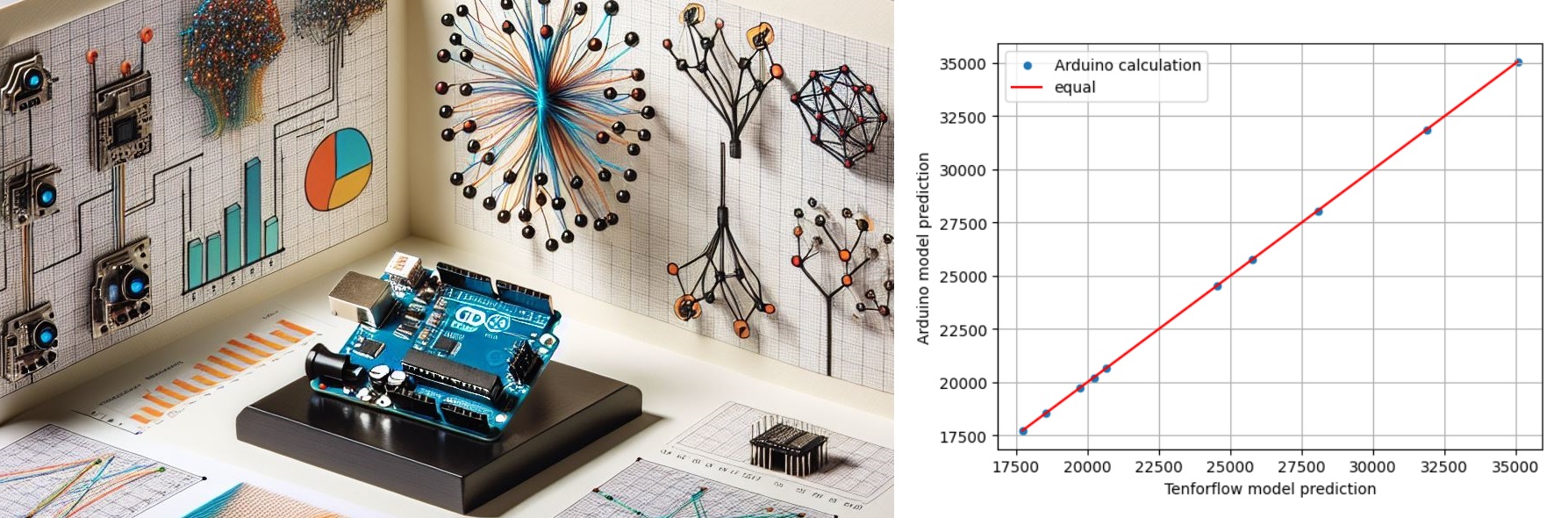
arduino_code=tf_model_to_arduino_code(tf_model, X, y, init_code)
Layer 0 W shape (4, 16) Bias shape (16,) Activation Function relu Layer 1 W shape (16, 8) Bias shape (8,) Activation Function relu Layer 2 W shape (8, 4) Bias shape (4,) Activation Function relu Layer 3 W shape (4, 1) Bias shape (1,) Activation Function linear
# save the arduino code
ino_file="../ArduinoCode/Tf_Model"
ino_file=ino_file.replace(".ino" ,"")
current_directory = os.getcwd()
new_directory_path = os.path.join(current_directory, ino_file)
try:
os.makedirs(new_directory_path)
except: pass
path=ino_file+"/"+ino_file.split("/")[-1]+".ino"
with open(path,'w+') as f:
f.write(arduino_code)
print(path, "saved")
../ArduinoCode/Tf_Model/Tf_Model.ino saved
The arduino memory usnig
# The arduino serial print result
serialPrint="""
Cal_Ardui,Expected,Delta_time(us)
17770.185546 , 17770.187500 , 4556
22208.960937 , 22208.962890 , 4420
16064.545898 , 16064.555664 , 4444
19372.082031 , 19372.083984 , 4412
19566.919921 , 19566.931640 , 4436
28578.988281 , 28578.988281 , 4528
33195.054687 , 33195.054687 , 4512
24006.271484 , 24006.269531 , 4508
22752.718750 , 22752.728515 , 4520
23988.726562 , 23988.726562 , 4536
====The End====="""
# Convert the serial result to DF
data = serialPrint.split("\n")[1:-1]
data=[x.split(",") for x in data]
DF_serial= pd.DataFrame( data[1:], columns= data[0]).astype("float32")
DF_serial
| Cal_Ardui | Expected | Delta_time(us) | |
|---|---|---|---|
| 0 | 17770.185547 | 17770.187500 | 4556.0 |
| 1 | 22208.960938 | 22208.962891 | 4420.0 |
| 2 | 16064.545898 | 16064.555664 | 4444.0 |
| 3 | 19372.082031 | 19372.083984 | 4412.0 |
| 4 | 19566.919922 | 19566.931641 | 4436.0 |
| 5 | 28578.988281 | 28578.988281 | 4528.0 |
| 6 | 33195.054688 | 33195.054688 | 4512.0 |
| 7 | 24006.271484 | 24006.269531 | 4508.0 |
| 8 | 22752.718750 | 22752.728516 | 4520.0 |
| 9 | 23988.726562 | 23988.726562 | 4536.0 |
print("The AVG prediction time of one input is",
(DF_serial['Delta_time(us)'].mean()/1000).round(2),
"ms"
)
The AVG prediction time of one input is 4.49 ms
# Ploting
DF_serial.plot.scatter(x='Expected', y='Cal_Ardui', marker='o', label="Arduino calculation")
xx=[DF_serial['Expected'].min(), DF_serial['Expected'].max()]
plt.plot(xx,xx, c='r', label="equal")
plt.legend()
plt.xlabel("Python model prediction")
plt.ylabel("Arduino model prediction")
plt.grid()
plt.show()
See the package link
https://pypi.org/project/mltoarduino
Conversion of Xgboost model to C++ (arduino language)
# Load the model
xgb_model = joblib.load(r'../models/xgboost/xgb_model.pkl')
sub_X=X_train[:10]
sub_y=xgb_model.predict(sub_X)
X=sub_X
y=sub_y
# Get the base score
base_score = xgb_model.base_score
print("Base Score:", base_score)
Base Score: 18476.805
booster=xgb_model.get_booster()
print(booster.get_dump(dump_format='text')[0])
0:[f1<129] yes=1,no=2,missing=2 1:[f1<91] yes=3,no=4,missing=4 3:[f2<6] yes=7,no=8,missing=8 7:leaf=-905.217285 8:leaf=-422.910553 4:[f3<47435] yes=9,no=10,missing=10 9:leaf=442.025391 10:leaf=-22.4555092 2:[f1<177] yes=5,no=6,missing=6 5:[f3<84687] yes=11,no=12,missing=12 11:leaf=948.198547 12:leaf=342.00119 6:[f3<136640] yes=13,no=14,missing=14 13:leaf=1401.38916 14:leaf=803.22821
l1=list(dfnew.columns)
l2=list(range(len(l1)))
dic={x1:'f'+str(x2) for (x1,x2) in zip(l1,l2)}
dic
{'Gearbox_auto': 'f0',
'HorseP': 'f1',
'Euro_stand': 'f2',
'km': 'f3',
'price': 'f4'}
l1=list(dic.keys())
# TO AVOID MISTAKE IN 'evHvBatteryEnergyLevel_lag' AND 'evHvBatteryEnergyLevel',
l1.sort()
l1=l1[::-1]
d=dict()
for x in l1:
d[x]=dic[x]
dic=d
dic
{'price': 'f4',
'km': 'f3',
'HorseP': 'f1',
'Gearbox_auto': 'f0',
'Euro_stand': 'f2'}
print(booster.get_dump(dump_format='text')[0])
0:[f1<129] yes=1,no=2,missing=2 1:[f1<91] yes=3,no=4,missing=4 3:[f2<6] yes=7,no=8,missing=8 7:leaf=-905.217285 8:leaf=-422.910553 4:[f3<47435] yes=9,no=10,missing=10 9:leaf=442.025391 10:leaf=-22.4555092 2:[f1<177] yes=5,no=6,missing=6 5:[f3<84687] yes=11,no=12,missing=12 11:leaf=948.198547 12:leaf=342.00119 6:[f3<136640] yes=13,no=14,missing=14 13:leaf=1401.38916 14:leaf=803.22821
txt=booster.get_dump(dump_format='text')[0]
for k in dic.keys():
txt= txt.replace(k, dic[k])
print(txt)
0:[f1<129] yes=1,no=2,missing=2 1:[f1<91] yes=3,no=4,missing=4 3:[f2<6] yes=7,no=8,missing=8 7:leaf=-905.217285 8:leaf=-422.910553 4:[f3<47435] yes=9,no=10,missing=10 9:leaf=442.025391 10:leaf=-22.4555092 2:[f1<177] yes=5,no=6,missing=6 5:[f3<84687] yes=11,no=12,missing=12 11:leaf=948.198547 12:leaf=342.00119 6:[f3<136640] yes=13,no=14,missing=14 13:leaf=1401.38916 14:leaf=803.22821
def txt_c_nodes2(tree_string,dic):
out=""
# Define the pattern for extracting the desired parts
pattern = r'(\d+):\[(\w+)([<>=]+)(-?[\d.]+)\]\s+yes=(\d+),no=(\d+),missing=(\d+)'
for k in dic.keys():
tree_string= tree_string.replace(k, dic[k])
#print(tree_string)
lines=tree_string.replace("\t","").split('\n')
for l in lines:
if "[" in l and "]" in l:
# Use re.findall to extract matching groups
matches = re.findall(pattern, l)
# Extracted parts
if matches:
for match in matches:
#condition, yes, no, missing = match
node,feature, cond, value, yes, no, missing = match
index=feature.replace("f","")
cond=cond.replace("=","==")
out+="node"+node+": if (X ["+index+"] "+cond+value+") goto node"+ yes+" ; else goto node"+no+" ; \n"
else:
if 'leaf=' in l :
#print(l)
node=l.split(':leaf=')[0]
leaf=l.split(':leaf=')[1]
out+='node'+node+': return ' + leaf+" ;\n"
return out
print(txt_c_nodes2(x,dic))
node0: if (X [1] <132) goto node1 ; else goto node2 ; node1: if (X [1] <129) goto node3 ; else goto node4 ; node3: if (X [2] <5) goto node7 ; else goto node8 ; node7: return 67.2528915 ; node8: return -4.22500849 ; node4: if (X [3] <55480) goto node9 ; else goto node10 ; node9: return 125.454178 ; node10: return -0.75947547 ; node2: if (X [1] <150) goto node5 ; else goto node6 ; node5: if (X [3] <176320) goto node11 ; else goto node12 ; node11: return -50.4777794 ; node12: return 346.403595 ; node6: if (X [3] <23600) goto node13 ; else goto node14 ; node13: return -66.9801254 ; node14: return 12.834815 ;
def trees_to_C2(booster,dic):
code=""
for i, x in enumerate (booster.get_dump(dump_format='text')):
code += "////////////////// TREE_"+str(i+1)
code += "\n"
code += "float tree"+str(i)+" ( float X[] ) {"
code += "\n"
code += txt_c_nodes2(x,dic)
code += "}"
code += "\n"
return code
base_score=X_train.mean()
base_score
18476.805
sub_X=X_train[:10]
sub_y=xgb_model.predict(sub_X)
X=sub_X
y=sub_y
base_score
18476.805
def all_arduino_code4(model,X,y, dic, base_score):
Xs=str(list(X)).replace('[','{').replace(']','}')
booster=model.get_booster()
code ="""
INIT_1
"""
xshape = X.shape
NvdimX = "const int Nv = " + str(xshape[0]) +\
";\nconst int dimX = " + str(xshape[1]) + ";\n"
Xystr = "\n/////// Xy ////// \nconst float X [] PROGMEM = " +\
array_to_arduino(X.flatten()) + ";\n\n" + \
"const float y[] PROGMEM = " + \
array_to_arduino(y.flatten()) + " ;\n\n"
code=code.replace("INIT_1", NvdimX + Xystr)
#print(code)
if model.base_score is not None:
code += "float base_score = " + str(model.base_score)+" ;"
else:
code += "float base_score = " + str(base_score)+" ;"
code += "\n"
if model.learning_rate is not None:
code += "float learning_rate = "+ str(model.learning_rate)+" ;"
else:
code += "float learning_rate = 1 ;"
code += "\n"
#code += "float X[]= "+Xs+" ;"
code += "\n"
code += trees_to_C2(booster, dic)
code += '/////////////////// XGBpredict'
code += "\n"
code +='float XGBpred(float X[]){'
code += "\n"
code +='float out = 0;'
code += "\n"
for i, x in enumerate (booster.get_dump(dump_format='text')):
code +="out= tree"+str(i)+"(X)+out;"
code += "\n"
code += "\n"
#code += "out = out*learning_rate+base_score;"
code += "out = out+base_score;"
code += "\n"
code +="return out;}"
code += "\n"
code += "\n"
code += """void setup() {
Serial.begin(115200);
}
void loop() {
unsigned long timestart;
unsigned long timeend;
float Xi[dimX];
float yc;
Serial.println("Cal_Ardui,Expected,Delta_time(us)");
for (int l=0;l<Nv;l++){
for(int j = 0; j<dimX;j++){
Xi[j]=pgm_read_float_near(&X[l*dimX+j]);
}
timestart=micros();
yc=XGBpred(Xi);
timeend=micros();
Serial.print(yc);
Serial.print(",");
Serial.print(pgm_read_float_near(&y[l]),6);
Serial.print(",");
Serial.println(timeend-timestart);
}
Serial.println("====The End=====");
while(1);
}
"""
return code
base_score=y_train.mean()
base_score
22734.895
X=X_test[0]
arduino_code=all_arduino_code4(xgb_model,sub_X, \
sub_y, dic,base_score)
ino_file="../ArduinoCode/Xgboost_Model"
current_directory = os.getcwd()
new_directory_path = os.path.join(current_directory, ino_file)
try:
os.makedirs(new_directory_path)
except: pass
path=ino_file+"/"+ino_file.split("/")[-1]+".ino"
with open(path,'w+') as f:
f.write(arduino_code)
print(path, "saved")
../ArduinoCode/Xgboost_Model/Xgboost_Model.ino saved
serialPrint="""
Cal_Ardui,Expected,Delta_time(us)
20222.40,20222.404296,2088
24689.11,24689.107421,1976
16387.31,16387.304687,1952
19894.63,19894.634765,1940
20383.30,20383.296875,1960
25561.64,25561.638671,1964
34748.62,34748.605468,2000
29990.77,29990.771484,1980
26085.88,26085.880859,1948
28298.82,28298.818359,1956
====The End====="""
data = serialPrint.split("\n")[1:-1]
data=[x.split(",") for x in data]
DF_serial= pd.DataFrame( data[1:], columns= data[0]).astype("float32")
DF_serial
| Cal_Ardui | Expected | Delta_time(us) | |
|---|---|---|---|
| 0 | 20222.400391 | 20222.404297 | 2088.0 |
| 1 | 24689.109375 | 24689.107422 | 1976.0 |
| 2 | 16387.310547 | 16387.304688 | 1952.0 |
| 3 | 19894.630859 | 19894.634766 | 1940.0 |
| 4 | 20383.300781 | 20383.296875 | 1960.0 |
| 5 | 25561.640625 | 25561.638672 | 1964.0 |
| 6 | 34748.621094 | 34748.605469 | 2000.0 |
| 7 | 29990.769531 | 29990.771484 | 1980.0 |
| 8 | 26085.880859 | 26085.880859 | 1948.0 |
| 9 | 28298.820312 | 28298.818359 | 1956.0 |
DF_serial.columns
Index(['Cal_Ardui', 'Expected', 'Delta_time(us)'], dtype='object')
print("The AVG prediction time of one input is",
(DF_serial['Delta_time(us)'].mean()/1000).round(2),
"ms"
)
The AVG prediction time of one input is 1.98 ms
DF_serial.plot.scatter(x='Expected', y='Cal_Ardui', marker='o', label="Arduino calculation")
xx=[DF_serial['Expected'].min(), DF_serial['Expected'].max()]
plt.plot(xx,xx, c='r', label="equal")
plt.legend()
plt.xlabel("Python model prediction")
plt.ylabel("Arduino model prediction")
plt.grid()
plt.show()